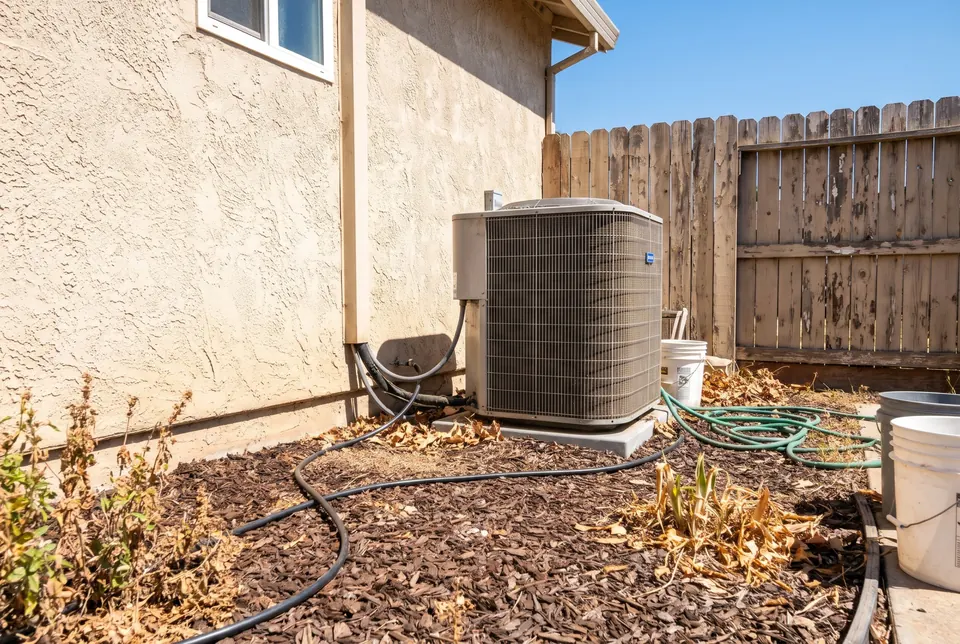
Sacramento summers are hard on air conditioners. Near downtown, July afternoons average 94.4°F, and the area sees about 23 days a year at 100°F or hotter, according to NOAA's 1991–2020 climate normals.
Call (916) 712-7030 to talk with a local AC repair technician about the problem. Ask about the price and the schedule, get a quote, and decide whether to hire them.
Services
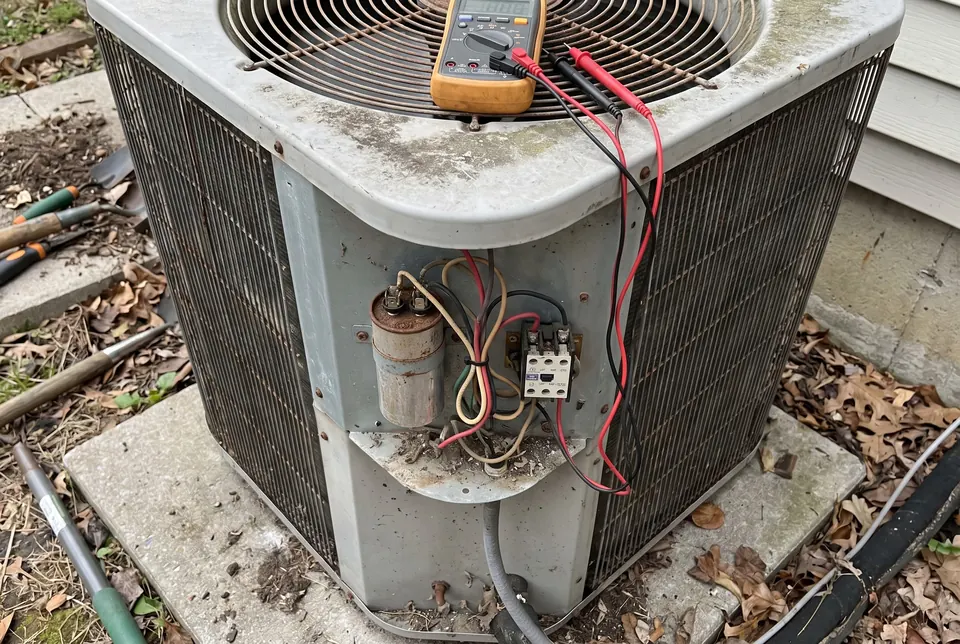
AC repair
Diagnosis and repair for systems that won't start, blow warm air, freeze up, leak water, or trip the breaker.
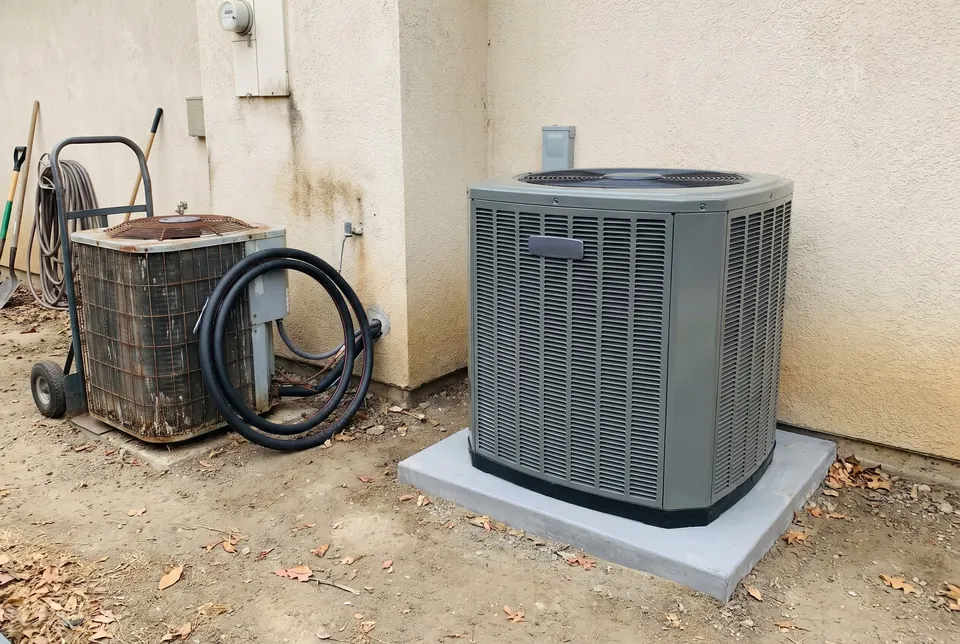
AC replacement
Replacing a worn-out central air conditioner, including the permit, duct test, and refrigerant check California requires.
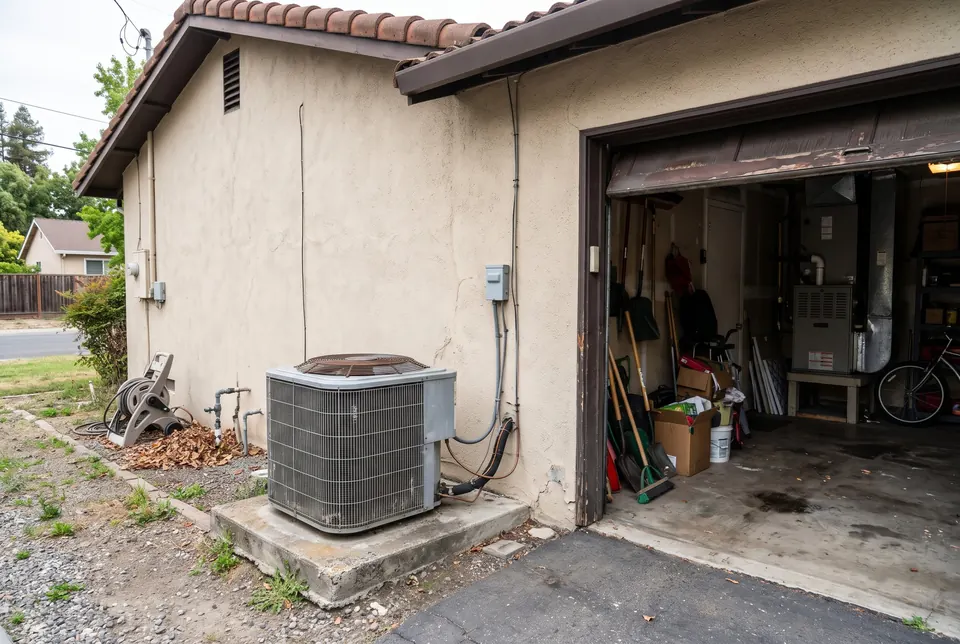
Heat pump installation
A heat pump cools in summer and heats in winter. SMUD lists rebates up to $3,000 when one replaces gas heat.
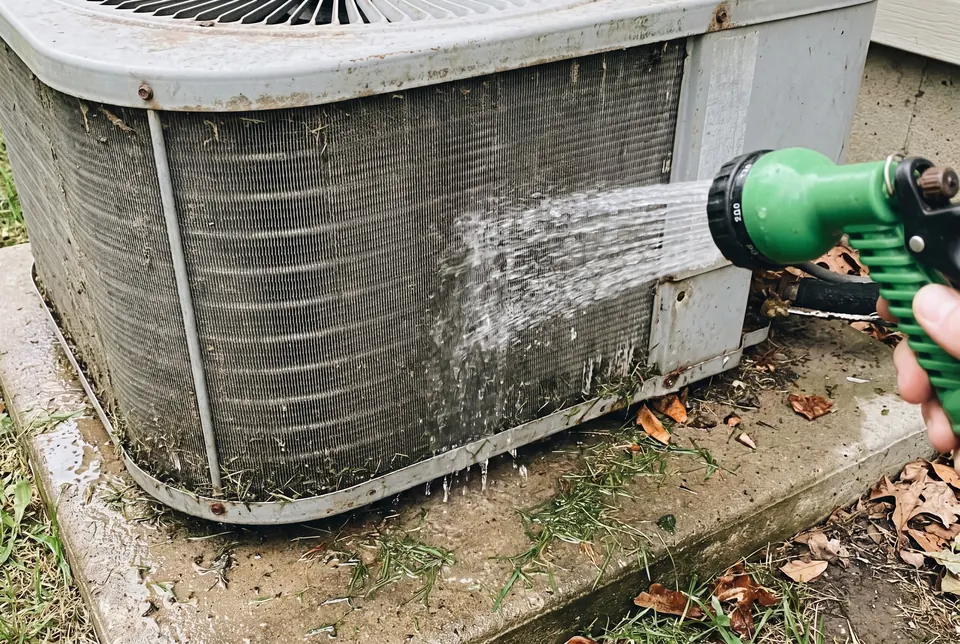
AC tune-up
A spring checkup of coils, refrigerant charge, electrical connections, and the condensate drain.
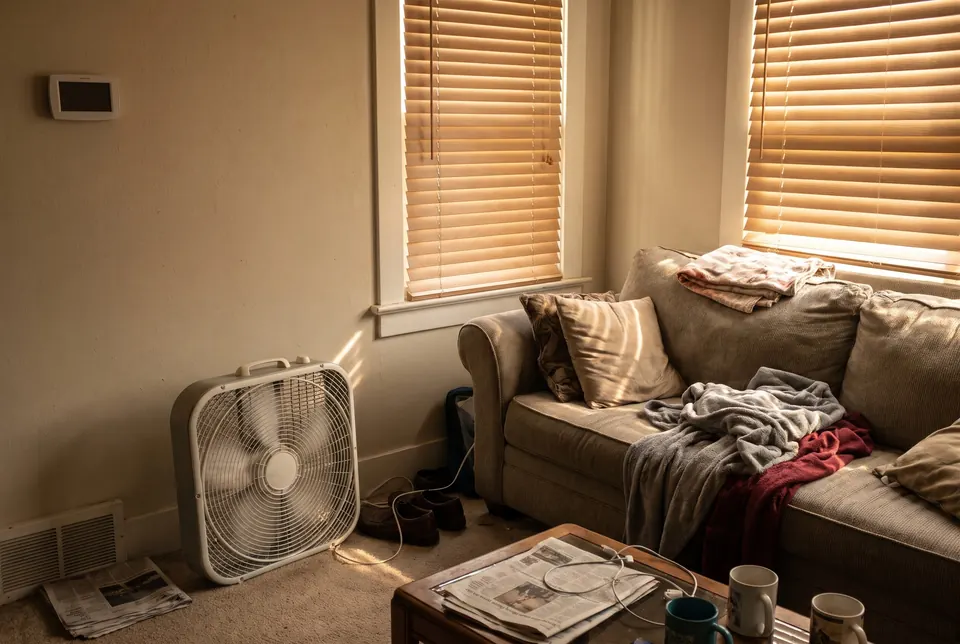
Emergency AC repair
What to check first and how to stay safe when your AC fails in a heat wave.
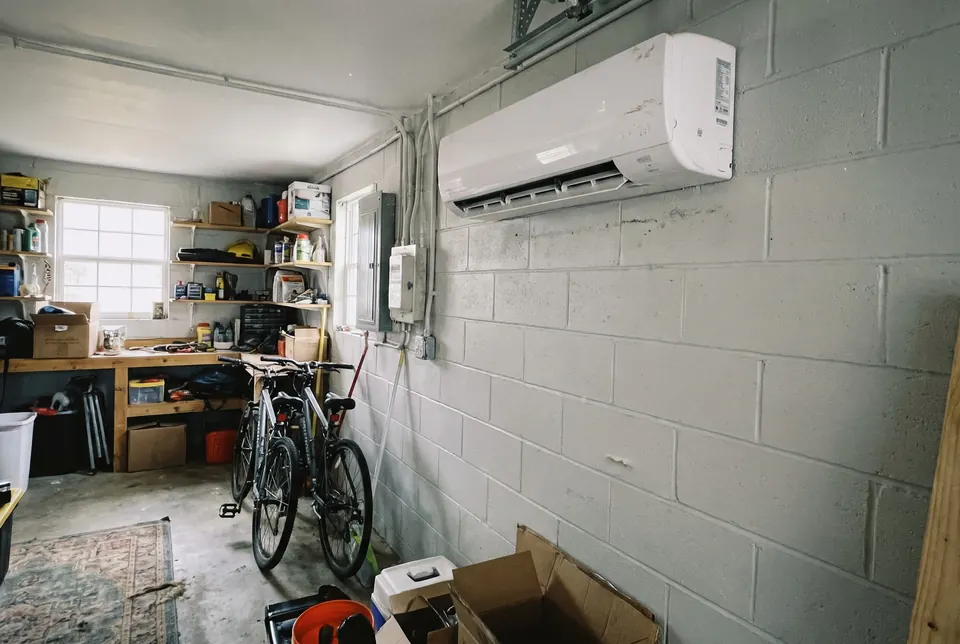
Ductless mini splits
Wall-mounted units that cool and heat rooms, additions, or homes without ductwork.
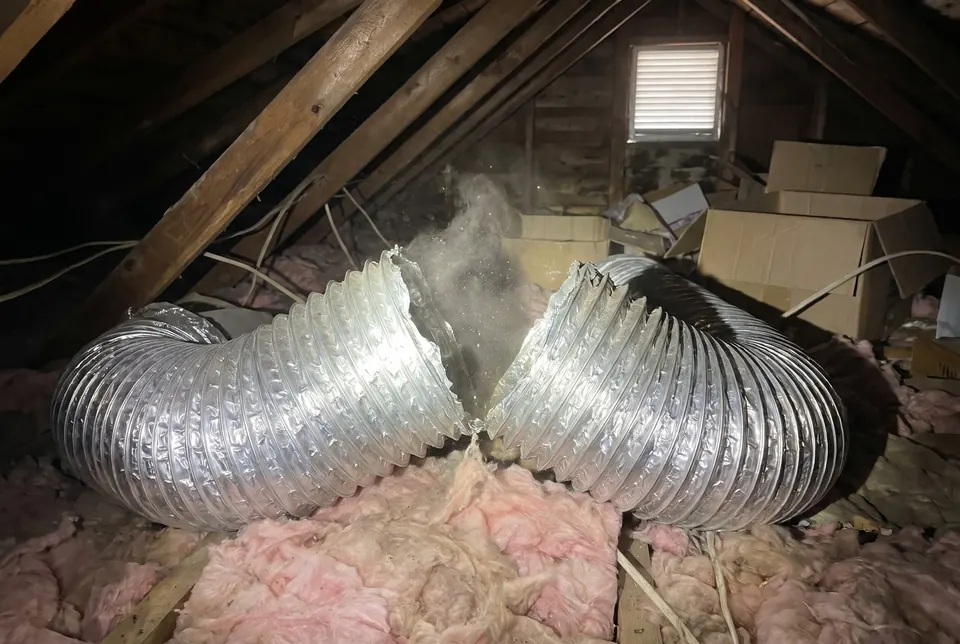
Duct sealing and repair
Fixing leaky, crushed, or disconnected ducts so cool air actually reaches your rooms.
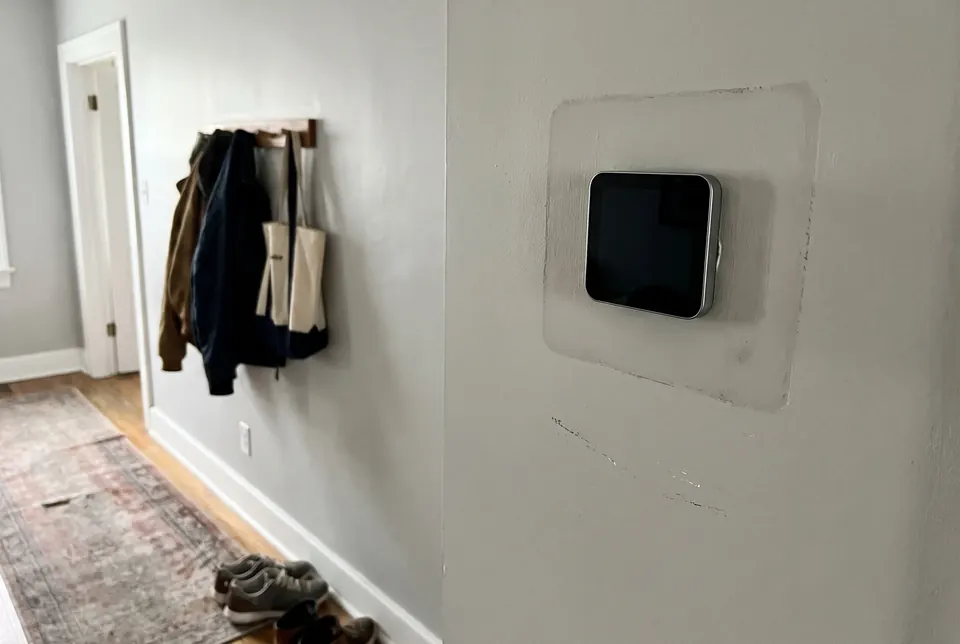
Thermostat replacement
Replacing a failed or outdated thermostat with a programmable or smart model.
Signs you should call
- Warm air from the ventsTrane lists a clogged filter, frozen coil, dirty outdoor coil, or low refrigerant as common causes.
- Ice on the indoor coil or refrigerant lineTurn the system off; Trane warns that running it frozen can cause major damage.
- Water pooling near the indoor unitA clogged condensate drain or cracked pan can overflow and damage floors and ceilings.
- Outdoor unit hums but the fan won't spinOften a failed capacitor or fan motor, which are electrical repairs for a pro.
- Breaker trips when the AC startsReset once. If it trips again, leave it off; repeat trips point to an electrical or compressor fault.
- Bills climbing with no change in useDirty coils or leaky ducts make the system run longer; ENERGY STAR says typical ducts lose 20 to 30 percent of their air.
- Burning or electrical smellTurn the system off at the thermostat and breaker. If you see smoke or flames, get out and call 911.
- Gas smell near the furnaceLeave the home right away, then call 911 and PG&E at 1-800-743-5000, as PG&E advises.
How hot does Sacramento get, and what does that mean for your AC?
NOAA's 1991–2020 normals for the station near downtown (Sacramento 5 ESE) show an average July high of 94.4°F and about 23 days a year at 100°F or above. Sacramento Executive Airport averages 92.6°F in July and about 14 triple-digit days a year.
Nights are kinder: the average July low near downtown is 61.4°F. The National Weather Service explains that the Delta breeze, a sea breeze that forms in the afternoon at the Carquinez Strait, can cool the Sacramento area when the marine layer is deep enough. On those evenings, open windows after sunset and close them in the morning to give your AC a rest.
Long runs in triple-digit heat are hard on worn parts, so ENERGY STAR recommends a cooling checkup every spring.
Who is allowed to repair or replace an air conditioner in California?
The Contractors State License Board (CSLB) licenses HVAC contractors under the C-20 Warm-Air Heating, Ventilating and Air-Conditioning classification, which covers equipment, ducts, controls, and filters. CSLB tells homeowners to confirm their contractor holds an active C-20 license, and you can look up any license on the CSLB website.
Since January 1, 2025, an unlicensed person may do small jobs up to $1,000 only if no permit is needed and they hire no workers. An AC or heat pump replacement needs a permit, so it always calls for a licensed contractor. Separately, the EPA requires Section 608 certification to service refrigerant equipment, and only certified technicians can buy refrigerant.
- Don't pay more than 10% down or $1,000, whichever is less (CSLB).
- Get a written contract with a 3-day right to cancel.
- Hold the final payment until the permit passes final inspection.
Do you need a permit to replace an AC or heat pump in Sacramento?
Yes. The California Energy Commission (CEC) says installing any space-conditioning appliance other than a plug-in room unit requires a building permit. In Sacramento, the permit comes from City of Sacramento Community Development Department, Building Division, and your contractor normally applies for it.
The 2025 Energy Code covers permits filed on or after January 1, 2026. When an outdoor unit, air handler, coil, or packaged unit is replaced, the connected ducts must be sealed and tested by a third-party rater (now called an ECC-Rater, formerly a HERS rater) to 10% total leakage or 7% leakage to the outside. The refrigerant charge must also be verified on heat pumps everywhere and on air conditioners in climate zones 2 and 8 through 15. Sacramento is Climate Zone 12.
The CEC's compliance manual lists exceptions, including duct systems under 40 feet, ducts already certified by a rater, and ducts that contain asbestos.
Should you repair or replace your air conditioner?
Repair usually makes sense for a newer system with one failed part, like a capacitor or clogged drain. ENERGY STAR suggests having a system evaluated once it's more than 10 years old, the Department of Energy lists that age as a reason to consider replacing, and This Old House says the best home systems usually last 12 to 15 years.
Two rules of thumb help: This Old House suggests replacing when age times repair cost tops $5,000, and Fixr when a repair costs more than half the price of a new unit. Many systems installed before 2010 use R-22, which hasn't been produced or imported in the U.S. since 2020, so the EPA says repairs rely on recycled or stockpiled supply.
What does the refrigerant change mean for your AC?
Under the federal AIM Act, new home AC and heat pump systems must use refrigerants with a global warming potential of 700 or less, so new systems are moving from R-410A to mildly flammable A2L refrigerants such as R-454B and R-32, which the EPA accepts with safety conditions.
You can keep repairing an R-410A system with matching parts for its whole life, the EPA says. An EPA rule finalized in May 2026 also lets R-410A equipment made or imported before January 1, 2025 be installed until that inventory runs out.
What AC and heat pump rebates are available in Sacramento in 2026?
As of November 2026, SMUD's rebate page lists $3,000 for a variable-stage heat pump that replaces gas heat, $2,000 for a two-stage model (15.2 SEER2 minimum) that replaces gas, and $1,000 for an electric-to-electric heat pump upgrade. A SMUD Contractor Network company must install it and file the rebate. SMUD lists no rebate for AC-only replacements.
Other programs have closed. The IRS says the federal 25C credit covered equipment placed in service through 2025. TECH Clean California's single-family heat pump incentives were reserved statewide as of November 14, 2025, and HEEHRA rebates were fully reserved as of February 24, 2026. PG&E's rebates page lists no residential AC or heat pump rebate, though its Energy Savings Assistance program serves income-qualified customers.
What temperature should you set your AC to in a Sacramento summer?
SMUD recommends 78°F or higher when you're home and says each 2 degrees higher saves about 5–10% on cooling. A ceiling fan lets you raise the setting about 4°F with no loss of comfort, according to the Department of Energy. ENERGY STAR's programmable thermostat guidelines used 85°F while you're out and 82°F overnight.
SMUD's Time-of-Day rate is highest from 5 to 8 p.m. on weekdays, and PG&E's E-TOU-C plan from 4 to 9 p.m. every day. SMUD suggests cooling the house earlier, then raising the thermostat during the peak.
How do you get an AC repair quote in Sacramento?
Call (916) 712-7030 and describe what's happening. You can talk through the problem with a local AC technician and get a quote. Agree on the visit, the price, and the work before anything starts.
- Ask for the CSLB license number, then check it online.
- Ask whether the diagnostic fee counts toward the repair.
- For a replacement, ask who pulls the permit and schedules the rater test.
What it typically costs
Most AC repairs cost $150 to $650 nationally in 2026, according to This Old House and Fixr. A new central AC runs roughly $5,800 to $14,400 installed (Fixr), and a central heat pump averages about $8,042 (This Old House). These are national figures, not Sacramento quotes, so get a written estimate. Call (916) 712-7030 to talk with a local AC technician.
| Job | Typical range | What drives the price |
|---|---|---|
| Diagnostic or service call | $75–$150 (This Old House); $75–$200 (Fixr) | Time of day and travel; often credited toward the repair |
| Capacitor replacement | $80–$400, avg. $175 (This Old House); $100–$400 (Fixr) | Capacitor type, access, and the service-call fee |
| Contactor or relay | $100–$450 (This Old House); $150–$400 (Fixr) | Part type and labor time |
| Condensate drain clearing | $80–$250 (This Old House); $75–$250 (Fixr) | Clog location; attic or crawlspace access |
| Refrigerant recharge (minor leak) | $200–$640, avg. $400 (This Old House); $250–$900, avg. $400 (Fixr, 2025) | Refrigerant type (R-22 costs most) and pounds needed |
| Refrigerant leak repair plus recharge | $200–$1,500+ (This Old House); $200–$1,600, avg. $800 (Fixr) | Where the leak is and how hard it is to reach |
Sacramento homes and local rules
What Sacramento's homes mean for your air conditioning repair
The median home in Sacramento was built in 1977, about 49 years ago, and 54% of homes predate 1980. With home cooling systems typically lasting 12 to 15 years (This Old House), many of these houses are on their second or third AC, while the attic ducts may still be original. Many systems installed before 2010 use R-22 refrigerant, which the U.S. stopped producing and importing in 2020, so repairs on those units get more expensive as supply shrinks.
About 30% of homes in Sacramento were built before 1960. In houses that old, ducts and cooling equipment have almost certainly been added or replaced over the years, and they may run through tight attics or crawlspaces that make work slower. An older electrical panel may also be too small for a new heat pump, so ask the technician to check panel capacity before quoting. In SMUD territory, SMUD's Go Electric rebates list up to $4,000 for a smart panel, subpanel, or new circuits; the subpanel and circuit rebates require switching from gas.
About Sacramento
Sacramento has long been called the 'City of Trees' for its large urban canopy, and its older central neighborhoods are served by a combined sewer system (sewage and stormwater in one pipe) while newer areas have separated sewers.
Local rules, utilities and conditions in Sacramento
SMUD supplies electricity in Sacramento and runs the region's main heat pump rebate program. As of November 2026, SMUD's rebate page lists $3,000 for a variable-stage heat pump that replaces gas heat, $2,000 for a two-stage heat pump (15.2 SEER2 minimum) that replaces gas, and $1,000 for an electric-to-electric upgrade. The installer must be in the SMUD Contractor Network and submits the rebate, and the job needs a permit and passing Title 24 testing. SMUD's Time-of-Day rate is highest from 5 to 8 p.m. on weekdays, so SMUD suggests cooling the house earlier and setting the thermostat to 78°F or higher during those hours.
Replacing an AC, heat pump, or mini split in Sacramento requires a building permit from City of Sacramento Community Development Department, Building Division. Under California's 2025 Energy Code, which covers permits filed since January 1, 2026, the ducts connected to new equipment must be sealed and tested by a third-party rater to 10% total leakage or 7% leakage to the outside, and the refrigerant charge must be verified on heat pumps and on air conditioners in most inland climate zones. Your contractor normally pulls the permit. CSLB warns against any contractor who offers a lower price to skip it, because the permit is what gets the work inspected.
Sacramento is on the Sacramento Valley floor, where summers are long and hot. The National Weather Service explains that the Delta breeze, a sea breeze that forms at the Carquinez Strait, can push cooler marine air inland when the marine layer is deep enough. Let the AC carry the afternoon, then open windows once it's cooler outside and close them in the morning. Attic ducts bake in valley summers, so sealed, insulated ducts matter as much as the AC itself.
Flood notes for Sacramento
The Natomas Basin is surrounded by 42 miles of levees, and the Army Corps began building another 24 miles of improvements in 2019 to reach at least 200-year flood protection.
Renting in Sacramento?
About 52% of homes in Sacramento are owner-occupied, so many residents rent. California law requires landlords to keep rentals habitable, and the Attorney General's tenant guide lists working heating, but not air conditioning, among the basics. Senate Bill 655 (2025) made a safe maximum indoor temperature state policy but did not create a statewide AC requirement for existing rentals. If your unit came with AC, check your lease for who handles repairs, report problems to your landlord in writing, and keep copies. Get written permission before hiring your own technician for a landlord's system.
Find an AC repair technician in your city
Each city page covers local permits, utilities and housing data.
- AC repair technician in Elk GroveSacramento County · homes built ~2000
- AC repair technician in RosevillePlacer County · homes built ~1998
- AC repair technician in FolsomSacramento County · homes built ~1997
- AC repair technician in Citrus HeightsSacramento County · homes built ~1977
- AC repair technician in Rancho CordovaSacramento County · homes built ~1979
- AC repair technician in RocklinPlacer County · homes built ~1998
- AC repair technician in LincolnPlacer County · homes built ~2005
- AC repair technician in DavisYolo County · homes built ~1983
- AC repair technician in West SacramentoYolo County · homes built ~1987
- AC repair technician in WoodlandYolo County · homes built ~1981
- AC repair technician in El Dorado HillsEl Dorado County · homes built ~2002
- AC repair technician in CarmichaelSacramento County · homes built ~1972
- AC repair technician in Fair OaksSacramento County · homes built ~1977
- AC repair technician in OrangevaleSacramento County · homes built ~1976
- AC repair technician in Arden-ArcadeSacramento County · homes built ~1966
- AC repair technician in AntelopeSacramento County · homes built ~1993
- AC repair technician in North HighlandsSacramento County · homes built ~1971
- AC repair technician in Granite BayPlacer County · homes built ~1987
- AC repair technician in Gold RiverSacramento County · homes built ~1991
- AC repair technician in Rio LindaSacramento County · homes built ~1969
- AC repair technician in GaltSacramento County · homes built ~1994
- AC repair technician in AuburnPlacer County · homes built ~1978
- AC repair technician in Cameron ParkEl Dorado County · homes built ~1987
- AC repair technician in PlacervilleEl Dorado County · homes built ~1975
- AC repair technician in LoomisPlacer County · homes built ~1980
Need an AC repair technician in the Sacramento area?
Call to talk to a local AC repair technician, describe the job and get a quote before any work starts. The call is free.
Frequently asked questions
How much does AC repair cost in Sacramento?
How long does a central air conditioner last?
Do I need a permit to replace my AC in Sacramento?
Can I recharge my AC refrigerant myself?
Does it cost anything to call?
Sources
- U.S. Climate Normals 1991-2020, monthly: Sacramento 5 ESE (USW00023271) — NOAA National Centers for Environmental Information (NCEI)
- U.S. Climate Normals 1991-2020, annual/seasonal: Sacramento 5 ESE (USW00023271) — NOAA National Centers for Environmental Information (NCEI)
- U.S. Climate Normals 1991-2020, monthly: Sacramento Executive Airport (USW00023232) — NOAA National Centers for Environmental Information (NCEI)
- U.S. Climate Normals 1991-2020, annual/seasonal: Sacramento Executive Airport (USW00023232) — NOAA National Centers for Environmental Information (NCEI)
- NWS Sacramento County Warning Area climate description (Delta Breeze) — National Weather Service, Sacramento
- Delta Breeze case study (Sacramento sea breeze and marine layer) — National Weather Service
- Maintenance Checklist (heating and cooling) — ENERGY STAR (EPA/DOE)
- C-20 Warm-Air Heating, Ventilating and Air-Conditioning Contractor classification — Contractors State License Board (CSLB)
- HVAC Upgrade Information for Consumers — Contractors State License Board (CSLB)
- Check a License or HIS Registration — Contractors State License Board (CSLB)
- Handyperson Exemption to Increase to $1,000 in 2025 (AB 2622) — Contractors State License Board (CSLB)
- HVAC consumer packet and HVAC Checklist (with the California Energy Commission) — Contractors State License Board (CSLB)
- Section 608 Technician Certification Requirements — U.S. Environmental Protection Agency (EPA)
- Refrigerant Sales Restriction — U.S. Environmental Protection Agency (EPA)
- Stationary Refrigeration: Prohibition on Venting Refrigerants — U.S. Environmental Protection Agency (EPA)
- 2025 Single-Family Heating, Ventilation, and Air Conditioning (HVAC) - Energy Code Support Center — California Energy Commission (CEC)
- 2025 Building Energy Efficiency Standards (applies to permits filed on or after January 1, 2026) — California Energy Commission (CEC)
- 2025 Single-Family Residential Compliance Manual, Chapter 9: Additions, Alterations, and Repairs — California Energy Commission (CEC)
- 2025 Reference Appendices (Joint Appendix JA2, Table 2-1: climate zone summary) — California Energy Commission (CEC)
- Heating & Cooling — ENERGY STAR (EPA/DOE)
- Energy Saver: Tips on Saving Money and Energy in Your Home (2022) — U.S. Department of Energy (DOE)
- Air Conditioner Repair Cost (2026 Pricing), updated March 16, 2026 — This Old House
- AC Repair Cost: Common Issues & When to Replace (2026), updated August 4, 2026 — Fixr
- HVAC Service Repair Costs (2026 Guide), updated October 22, 2026 — Fixr
- Purchasing and Repairing Home Air-Conditioners or Heat Pumps (HCFC-22 phaseout) — U.S. Environmental Protection Agency (EPA)
- Technology Transitions HFC Restrictions by Sector — U.S. Environmental Protection Agency (EPA)
- Fact Sheet: Final Rule, Reconsideration of Certain Technology Transitions Requirements (May 2026) — U.S. Environmental Protection Agency (EPA)
- Frequent Questions on the Phasedown of Hydrofluorocarbons (homeowner questions on split systems) — U.S. Environmental Protection Agency (EPA)
- Substitutes in Residential and Light Commercial Air Conditioning and Heat Pumps (SNAP) — U.S. Environmental Protection Agency (EPA)
- Heating and cooling rebates — Sacramento Municipal Utility District (SMUD)
- Energy Efficient Home Improvement Credit — Internal Revenue Service (IRS)
- Single-Family Incentives (TECH Clean California and HEEHRA status) — TECH Clean California (Energy Solutions, under the CPUC)
- Rebates and incentives — Pacific Gas and Electric Company (PG&E)
- Energy Savings Assistance Program — Pacific Gas and Electric Company (PG&E)
- Heating & Cooling tips — Sacramento Municipal Utility District (SMUD)
- ENERGY STAR Program Requirements for Programmable Thermostats, Version 1.2 (default setpoints) — ENERGY STAR (EPA)
- Time-of-Day (5-8 p.m.) Rate — Sacramento Municipal Utility District (SMUD)
- Time-of-Use Rate Plans — Pacific Gas and Electric Company (PG&E)
- AC Not Blowing Cold Air? Learn What to Do — Trane
- What To Do If the AC Evaporator Coil Is Frozen — Trane
- Air Handler Dripping Water: Causes and Solutions — Trane
- Duct Sealing — ENERGY STAR (EPA/DOE)
- Gas safety — Pacific Gas and Electric Company (PG&E)
- American Community Survey 2020–2024 5-year estimates (tables B01003, B25003, B25024, B25034, B25035) — U.S. Census Bureau